Taking a Munich R&D Tax Credit Leader into the US Market
A working demand engine across Meta, LinkedIn and outbound for a European market leader entering the United States, and a sales calendar filled with senior US decision-makers.
← Back to BlogTwo consecutive reporting periods between 29 January and 27 March 2026. Client identity, personnel and logos withheld under confidentiality.
The client
One of Europe's most established R&D tax credit specialists. Munich-based, 2,100+ companies served across manufacturing, consumer goods, banking, logistics, food and life sciences.
Their platform runs raw project data through an innovation test built by Master's and PhD-level experts, and produces an audit-ready claim file. In Germany, the incumbent. In the United States, unknown.
The mandate: build US pipeline from zero, in a category where the buyer's dominant emotion is fear of an IRS audit, and the dominant objection is "we already have a CPA."
The challenge
The product is invisible
Nobody wakes up wanting R&D tax credit documentation software. They want money back without risk. The offer had to be reframed from software to outcome.
The buyer is scared, not curious
CFOs and Controllers had all heard the same rumour: that claiming the credit invites an audit. "Maximise your claim" triggers exactly the wrong instinct.
Volume alone was worthless
The client's economics only work above a certain company size. A funnel full of five-person startups looks excellent on a dashboard and produces nothing.
Three market entries, three arguments
Each market got its own front door, matched to how that market actually thinks about the incentive.
The audit-anxiety angle
"How confident are you in your R&D documentation if the IRS audits tomorrow?"
Leads with Form 6765 and the IRS four-part test. Compliance-first promise: we'd rather under-claim a little and keep you 100% safe. The Head of US Strategy fronts the consultation, so the call has a real person attached.
The emotional variant
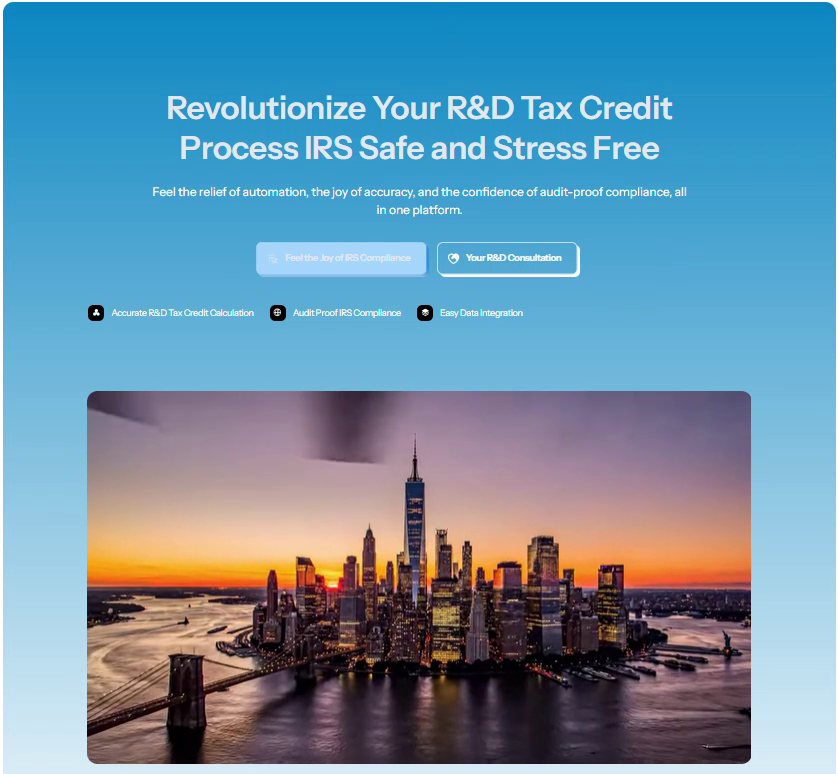
"Revolutionize Your R&D Tax Credit Process: IRS Safe and Stress Free"
Aerial New York hero video, with CTAs written as feelings rather than functions: Feel the Joy of IRS Compliance. Three pillars under the fold: accurate calculation, audit-proof compliance, easy integration.
The CIR angle
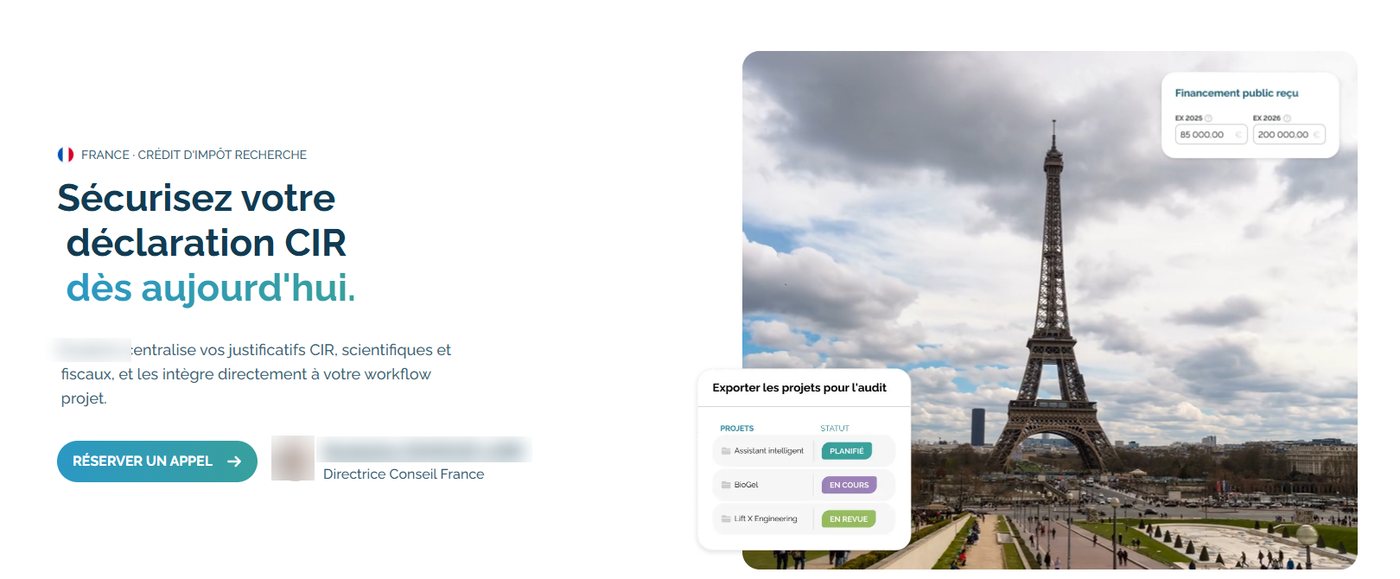
"Sécurisez votre déclaration CIR dès aujourd'hui."
Different incentive, entirely different frame. Centralises CIR scientific and fiscal evidence, with an audit export showing live project statuses. The France Consulting Director fronts the booking.
The creative engine
We ran a wide test rather than betting on one idea, then let spend follow the winners. Two ideas separated from the pack almost immediately, and one came back from the dead.

"Stop Leaving Money on the Table"
Loss aversion"80% of companies leave R&D tax credits unclaimed because documentation feels impossible."
"750K Claims Processed"
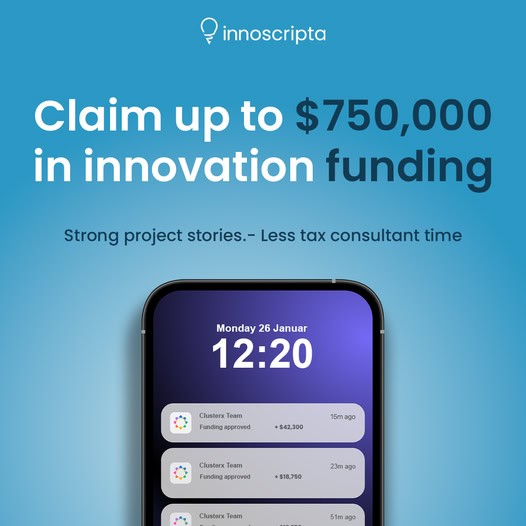
Proof of scale, rebuilt"Claim up to $750,000 in innovation funding: strong project stories, less tax consultant time."
"$7.6 Million in Claims"
Proof of scaleNo cleverness, just a number large enough to make a finance leader stop scrolling.
The workhorse ad is the one on the left: a visible $380K estimated credit stamped APPROVED, and three risk-removal badges ($0 upfront, IRS audit-ready, zero engineer work) dismantling the three reasons a CFO says no before they got the chance to say it.
Two creatives produced 52 of the launch period's 81 leads, 64% of all results from two ideas.
A Reddit-style video, a "Zero Hassle" simplicity angle and a "$0/Month Risk-Free" offer all lost and were cut. The last one is the one worth studying: for this buyer, removing price risk is far less persuasive than removing audit risk. That insight now shapes every new creative brief on the account.
The full test matrix
| Creative concept | Angle | Leads | Verdict |
|---|---|---|---|
| "Stop Leaving Money on the Table" | Loss aversion | 47 | Winner · 44% of spend |
| "$7.6 Million in Claims" | Proof of scale | 28 | Winner · 35% of launch spend |
| "750K Claims Processed" | Proof of scale, rebuilt | 21 | Turnaround · worst to best |
| "Reddit-Style Video" | Social proof | 5 | Cut |
| "Track Your R&D" | Product / control | 3 | Efficient but under-funded |
| "Runway Ad" | Brand / awareness | 2 | Efficient but under-funded |
| "Zero Hassle" | Simplicity | 1 | Cut |
| "$0/Month Risk-Free" | Price-risk removal | 0 | Cut · the useful failure |
Creative-level attribution across both periods. "Track Your R&D" and "Runway Ad" produced leads at genuinely efficient rates. They simply never got enough budget to prove it. They are the first two candidates for the next scaling round, and they only surfaced because the test stayed wide.
Results
46 intro calls booked across the two periods. Reach nearly doubled between them.
Period over period
Launch (29 Jan – 25 Feb) compared with scaled (1 – 27 Mar 2026)
Professionals reached
Intro calls booked
Each panel is scaled to its own metric. The two are not on a shared axis.
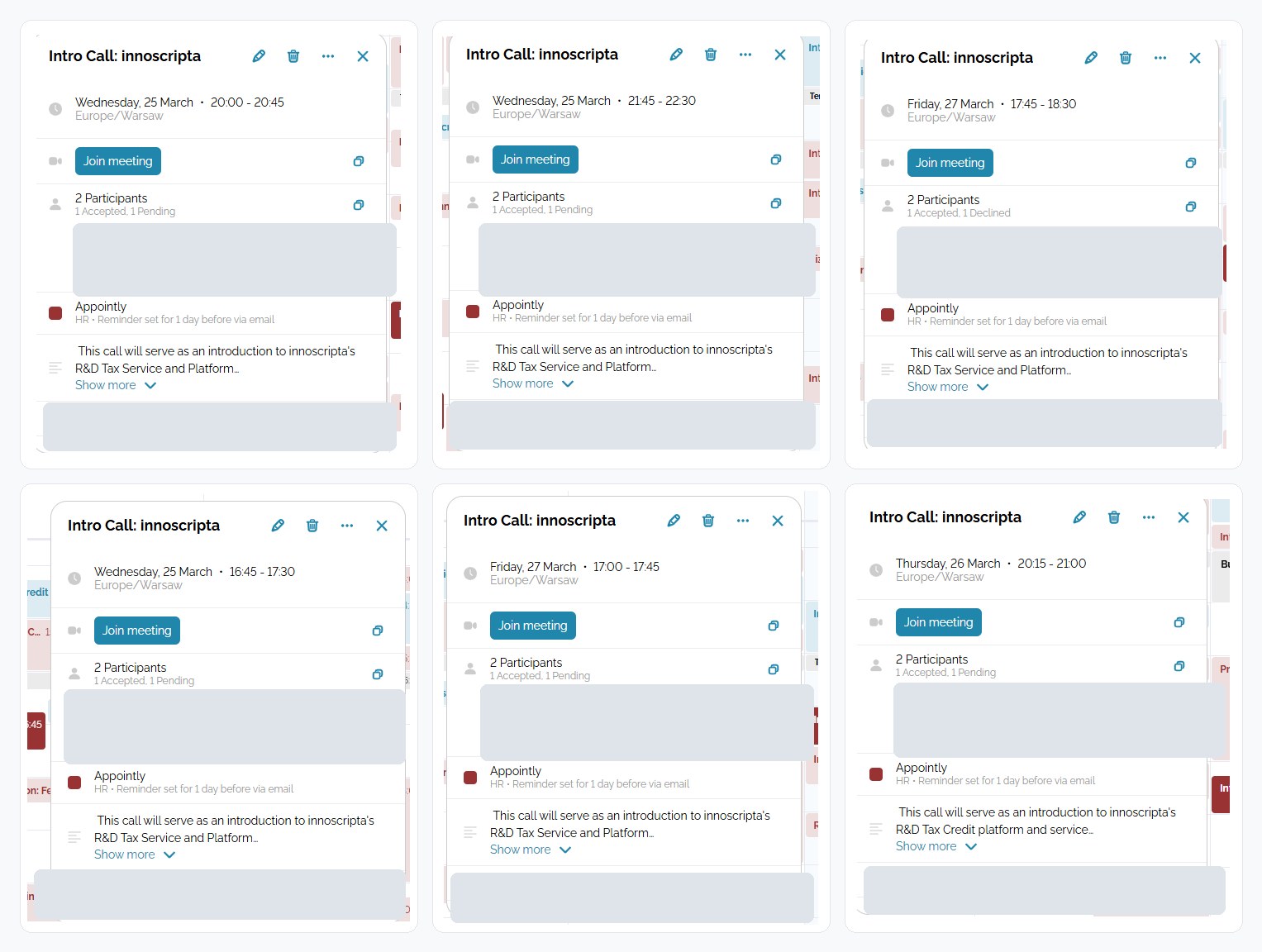
These weren't dashboard numbers. Every booking landed in the team's live calendar as a named intro-call event with two participants and a fixed agenda, shown at the top of this case study.
Two campaigns, two different jobs
| Campaign | Period | Leads | Appts |
|---|---|---|---|
| Primary Lead Gen (CBO, US) | Launch | 38 | 4 |
| Secondary Lead Campaign (US) | Launch | 43 | 5 |
| Primary Lead Gen (CBO, US) | Scaled | 24 | 10 |
| Secondary Lead Campaign (US) | Scaled | 25 | 4 |
| Qualified total | Both periods | 130 | 23 |
| All bookings | Both periods | 130 | 46 |
Scaled-period appointments are qualified only: 37 booked, 14 passed qualification. The launch period had no qualification filter in place.
This produced the account's clearest strategic signal: in the scaled period the CBO campaign delivered fewer leads but more than twice the qualified appointments, 10 against 4. Volume and quality were coming from different places, and that now drives how budget gets split.
We built a filter, not just a funnel
The most valuable thing shipped in the second period wasn't an ad. It was a qualification layer that scores every inbound lead and routes it automatically, before it reaches a salesperson.
Twenty-three rejections isn't twenty-three failures. It's twenty-three hours of senior sales time that never got wasted.
No ad platform can stop unqualified people entering a funnel. What separates a working account from a leaky one is what happens in the ninety seconds after they do.
Beyond paid social
Meta was the primary engine, but never the only one.
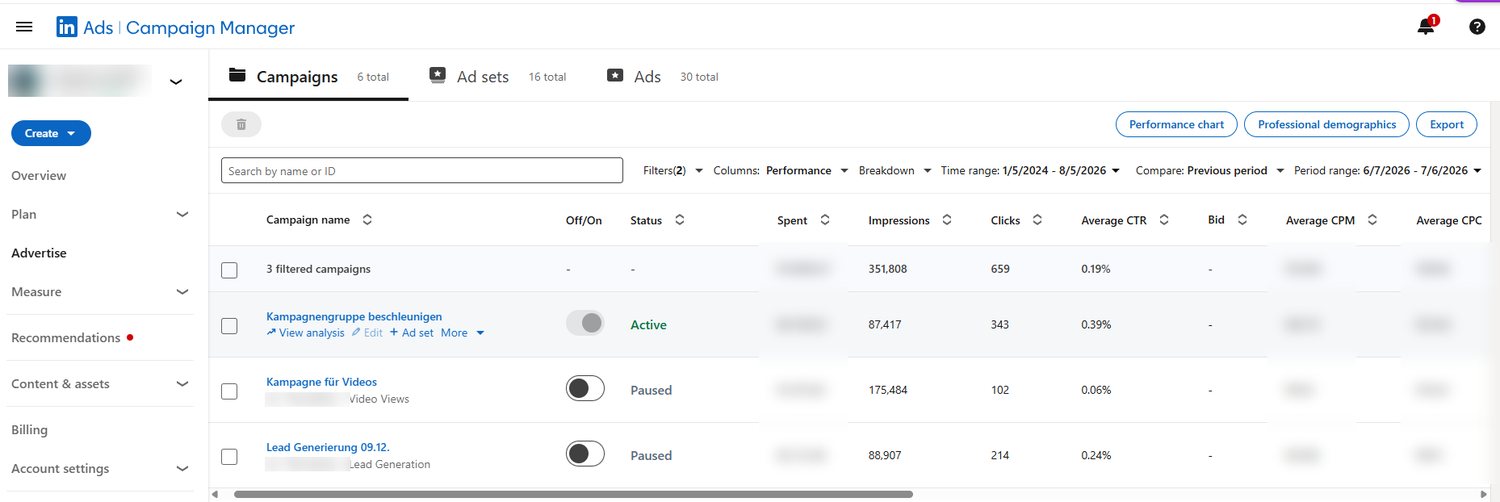
LinkedIn Advertising
Lead gen and accelerator groups clearly beat video views on click-through, so budget was consolidated instead of keeping three formats limping along.
Manual Prospecting
Named decision-makers only, warming the exact same audience paid social was already reaching.
Outbound Email
The sequence got stronger as it scaled rather than decaying, the opposite of what usually happens when outbound volume goes up.
The stand-out figure sits at the bottom of the outbound funnel. In the scaled period, 85% of everyone who clicked actually landed and stayed on the page, the clearest signal that the message and the landing page were finally saying the same thing. Open rate rose from 41% to 47% while volume quadrupled.
The work nobody puts in a case study
A meaningful share of the second period went into finding out why good traffic wasn't converting. Six issues found. Three fixed.
Booking page broken on mobile
The calendar widget sat below the fold on mobile, where most ad traffic lands. A large share of visitors never saw a calendar at all.
CAPTCHA before the booking step
Leads who had already decided to book were asked to prove they were human, and abandoned at the final click. Removed.
Calendar availability was lying
Showing as little as one available hour per day while the sales team had far more open. Fixed through a sync rebuild with sales.
No appointment reminders
Nothing automated between booking and the call itself. Documented in the client report.
No real-time lead notifications
Sales isn't alerted the moment a qualified lead lands, so speed-to-lead is left to chance.
No owner for marketing-tech issues
The real bottleneck. Issues fixable in a day currently take a week, and closing that gap costs nothing in media.
The headroom
40–60% more leads from the same budget. Two concepts are proven at volume, two more at efficiency and under-funded, four are cut. Moving spend out of the cut concepts into the winners, plus closing the three open operational blockers, is a compounding gain, not an incremental one. No increase in media investment required.
What we'd tell the next client
- Test the emotion, not the offer."$0/Month Risk-Free" lost to "audit-ready." In a fear category, the currency isn't price. It's safety.
- Don't kill a loser. Interrogate it."750K Claims Processed" went from the bottom of the account to a top performer on a rewrite, not a rebuild.
- Two ideas usually carry the account.64% of launch-period results came from two creatives. The job of the other six was to find those two.
- Filter early or pay later.Adding qualification cost volume on paper and bought back the sales team's calendar in reality.
- Half of paid media isn't paid media.A hidden mobile calendar and a badly placed CAPTCHA cost more conversions than any bid adjustment could have recovered.
Client name, personnel, logos and commercial figures withheld or redacted under confidentiality. Reporting periods: 29 January – 25 February 2026 and 1 – 27 March 2026.
Ready to see similar outcomes in your account?
Book a 30-minute call. We'll cover your current stack, the gaps, and what a first 90 days would look like.
Book a Call →